Originally posted on GoodReads.
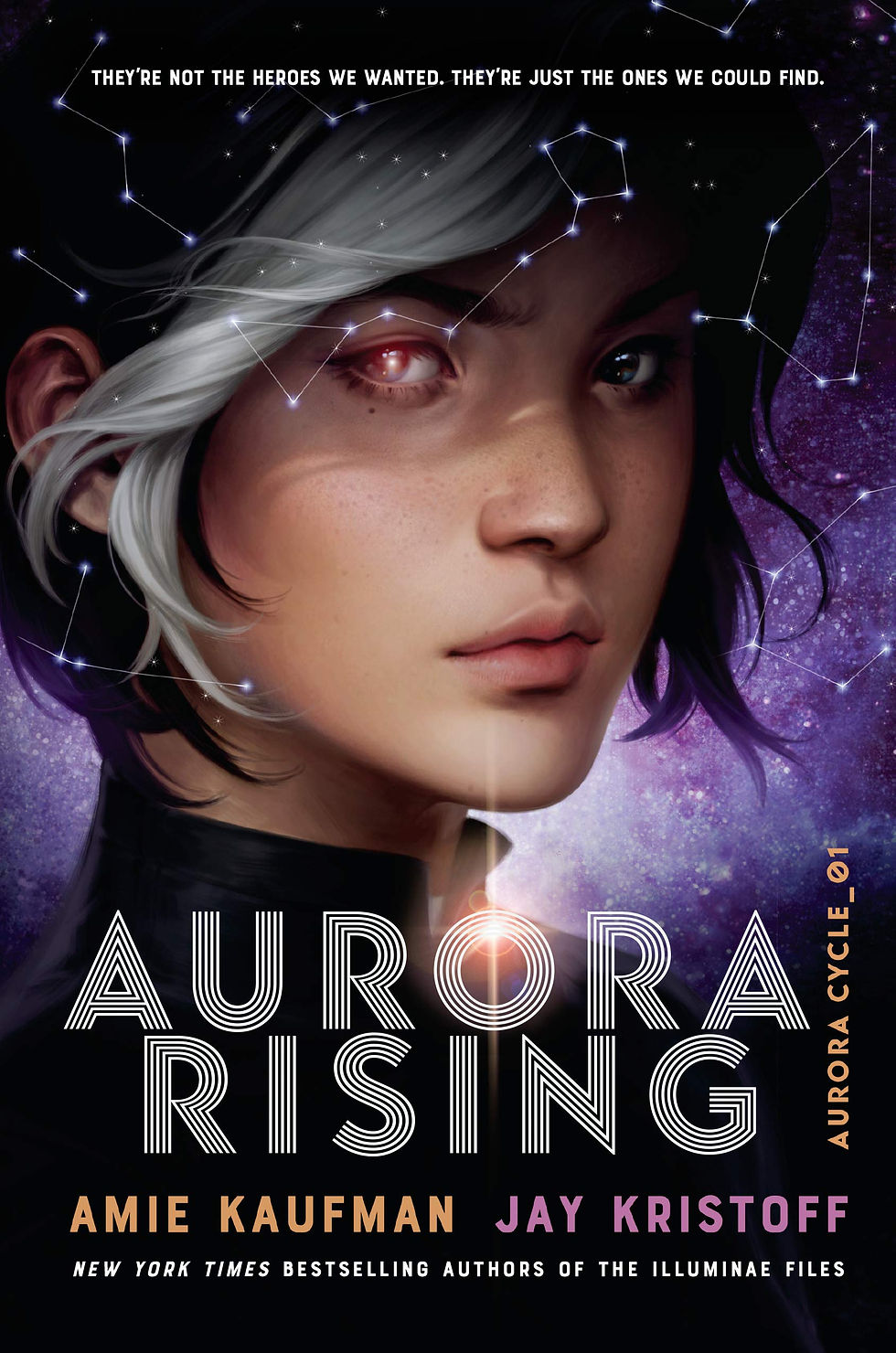
Synopsis: The year is 2380, and the graduating cadets of Aurora Academy are being assigned their first missions. Star pupil Tyler Jones is ready to recruit the squad of his dreams, but his own boneheaded heroism sees him stuck with the dregs nobody else in the Academy would touch…
A cocky diplomat with a black belt in sarcasm
A sociopath scientist with a fondness for shooting her bunkmates
A smart-ass techwiz with the galaxy’s biggest chip on his shoulder
An alien warrior with anger management issues
A tomboy pilot who’s totally not into him, in case you were wondering
And Ty’s squad isn’t even his biggest problem—that’d be Aurora Jie-Lin O’Malley, the girl he’s just rescued from interdimensional space. Trapped in cryo-sleep for two centuries, Auri is a girl out of time and out of her depth. But she could be the catalyst that starts a war millions of years in the making, and Tyler’s squad of losers, discipline-cases and misfits might just be the last hope for the entire galaxy.
They're not the heroes we deserve. They're just the ones we could find. Nobody panic.
Rating: 2.5/5
Expectation: Guardians of the Galaxy but with teenagers! Exciting, fun, full of snarky banter, and, ultimately, rooting for them to save the day!
Reality: Too. Much. Sarcasm. One-dimensional characters flatter than paper. Hey, haven't I seen this plot point before somewhere else?- Oh, my God, it's just Mass Effect, Halo, Stranger Things, and Guardians of the Galaxy all thrown together.
Could've been so much more. Unfortunately, it wasn't.
Aurora Rising is the first novel of a science fiction series (duology? trilogy?), co-authored by YA duo Amie Kaufman and Jay Kristoff, that aspires to bring together a ragtag group of misfits at the bottom ranks of a space academy to be the galaxy’s last hope against an age-old alien war after their captain rescues a cryogenically frozen girl who was found on a derelict ship gone missing two centuries prior. The premise is perfect for a time of science fiction pseudo-renaissance, thanks to the Star Wars sequels kicking off a renewed mainstream interest in galaxies far away. Aurora Rising contains many common tropes from other sci-fi media to make an exciting action adventure novel. Science fiction often borrows from itself in repeated cycles, so this isn’t an issue. For its intended audience, which I believe would be teenagers and young adults who are looking for fun found-family bantering in space a la Guardians of the Galaxy but if they were all teens, Aurora Rising is the perfect book for them, period. However, it did not stand out as remarkable to me. I mentioned Star Wars and Guardians of the Galaxy above as well as the novel containing many common tropes from sci-fi. That’s the book’s most glaring fault. It's a cobbling together of the things that make other media good except that, when all of those tropes have been patched together, the end result is something that is okay at best. This is meant to be a character-driven novel yet the characters are flimsy stereotypes defined by their roles in the squad. Even the book jacket summary reduces them to descriptions such as “star pupil Tyler Jones”, “a cocky diplomat with a black belt in sarcasm”, “an alien warrior with anger management issues”, and “a tomboy pilot who’s totally not into Ty, in case you were wondering” — and that’s not the entire squad yet. The book jumps between seven perspectives of each member of the squad but never quite utilizes that time spent with each of them wisely. Tyler’s, the captain, core personality trait is “obedient to the rules”; his best friend’s, Cat, chapters constantly bring up her internal monologue of how she’s upset that they slept together on their last shore leave and then he brushed her off after while she still pines for him; Tyler’s twin, Scarlett, is highlighted only for her good looks and promiscuous dating past; the one bisexual character in the book (not explicitly stated but heavily subtexted), Finian, spends most of his time filling the page with witty jokes that get aggravating since everyone on the squad is dry and sarcastic (and this isn’t even touching how Finian’s bisexuality only ever displays itself as him finding almost every one of his friends hot and commenting on it too frequently and at inappropriate times); and Zila, a character that reads as autistic-coded, is instead brushed off in an ableist argument, none of her friends try to make the effort to understand why she’s so much of a quiet loner but instead want her to try to understand them only, and all of her chapters (two to four at most in a thirty-five chapter book) that could be used to let the reader understand her more are reduced to being a page and a half at longest. And she’s labeled as a sociopath. The squad is set up in a Dungeons & Dragons style team composition but in space — Tyler is the Alpha (captain); Scarlett is the Face (diplomat); Cat is the Ace (pilot); Finian is the Gearhead (mechanic); Zila is the Brains (science/medical); Kal is the Tank (fighter); Aurora is the mysterious Deus Ex Machina character (see Eleven from Stranger Things) — and, unfortunately, the fact that their world and the authors confine them to these roles makes them read as utterly one-dimensional. The novel could be very character-driven and has morsels of good character focus, but it constantly leaves those morsels behind as the plot progresses. As a second point, the plot is horribly paced and doesn’t leave room for any character agency whatsoever; it’s too fast and moves at the rate of “author’s will”. The characters don’t have any say in what happens and sometimes don’t even make decisions of their own about what to do next; the decisions are made for them in the strange supernatural occurrences that revolve around Aurora’s mysterious powers, and they just follow along blindly (this is pointed out in-universe by Cat but then is handwaved). There’s no driving motivations for most of the squad besides them doing either what Tyler orders them to do or, in Tyler’s case, “having faith”. Having faith is not a real character motivation. I'm not entirely a Debbie Downer, so I will say some things that I enjoyed about the book: 💫 The last 50-100 pages are what the book probably should have been. The plot reveals itself (instead of being put together on contrived coincidences), characters suddenly get small bits of development they should've gotten 200 pages earlier, and I'm actually invested in them. Honestly, this is the 0.5 part of my rating otherwise it would've been a flat 2.0. 💫 Finian's culture! Around page 190-ish, he talks a bit to Scarlett about his Betraskan culture and how they live underground. It was some organic-feeling stuff. That's not just... "space elf" (looking at you, Kal). 💫 Zila. Wish she had more than, like, four pages total in her entire perspective. She reads as extremely autism-spectrum-coded but the whole issue is how everyone else treats her; instead of talking to her, Tyler just mouths off and brings her to tears about how she can't understand people. Not cool, Captain Dude. 💫 I'll be honest, somehow the read-into-subtext pairings worked better than the actual text pairings. The last third of the book does make Scarlett/Finian and Kal/Aurora begin to work a bit, but I found Tyler/Kal and Scarlett/Aurora galaxies more interesting tbh. Also? Three heterosexual romances? For the love of God, please. I thought you said space was "rainbow-colored", Kristoff. "Rainbow-colored" isn't "three white humans, one biracial human, one black girl who barely speaks, and two aliens, one of whom is bisexual and physically disabled." Aliens aren't representation, as much as YA sci-fi would like to believe they are. (Especially not when they're just space elves or space humanoids.)